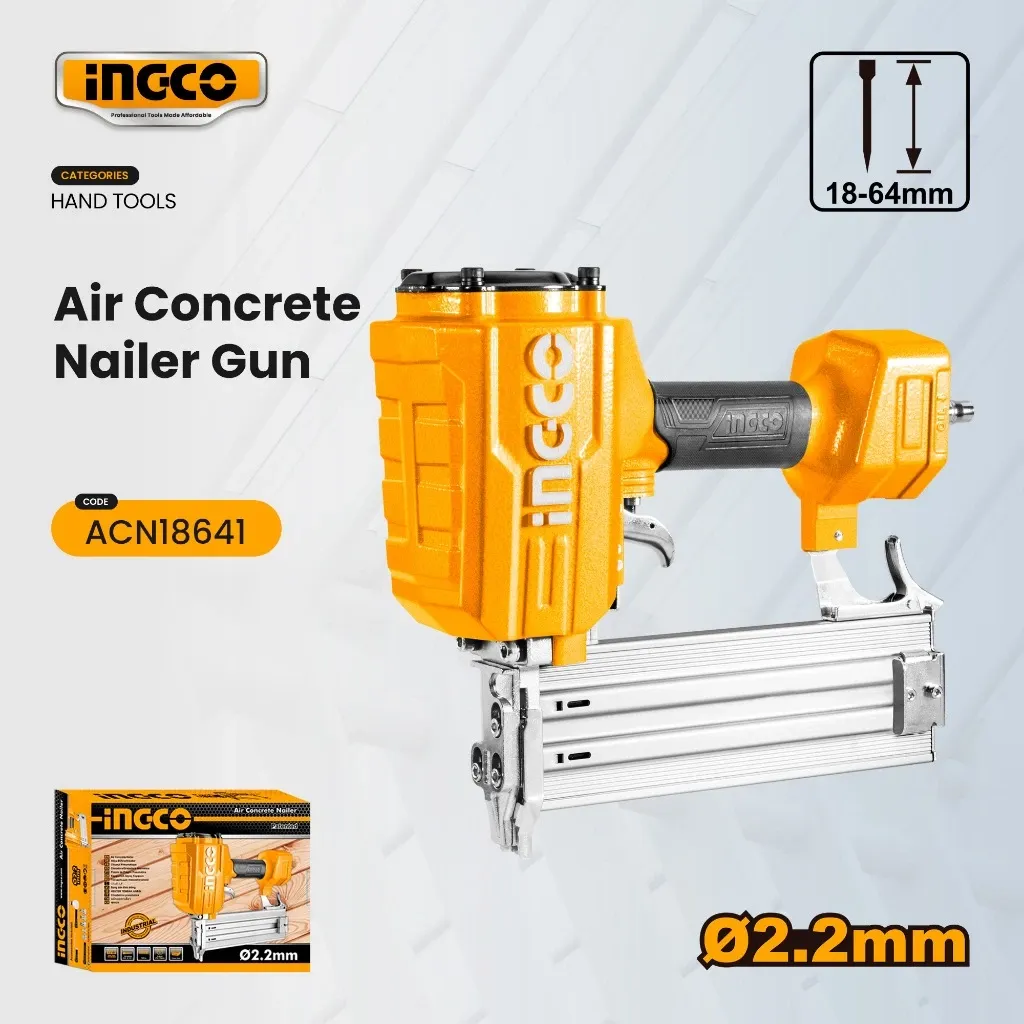
Ingco ACN18641 Pneumatic Air Concrete Nailer, 18-64mm
₱4,400as of Aug 30, 2026
COD · Shopee-protected payment

How we reviewed this: we read the Shopee PH listing, checked the listed specs, and went through the owner reviews.
Ingco ACN18641 Pneumatic Air Concrete Nailer, 18-64mmOur Best for concrete: fires hardened 2.2mm nails from 18mm to 64mm straight into concrete and hollow block, at around ₱4,400. The catch is that it is a specialist tool and it needs a compressor with real tank volume.
₱4,400as of Aug 30, 2026
COD · Shopee-protected payment
| Brand | INGCO |
|---|---|
| Type | Pneumatic concrete nailer |
| Price | ₱4,400 (as of Aug 30, 2026) |
| Shopee owner rating | 4.9 ★ from 17 Shopee ratings |
| Shop | ingco |
| Units sold | 50 |
Specs per the Ingco ACN18641 product page
| Type | Pneumatic concrete nailer |
|---|---|
| Model | ACN18641 |
| Nail length | 18mm to 64mm |
| Nail diameter | 2.2mm |
| Fastens to | Concrete, brick and masonry |
| Power source | Compressed air |
The Ingco ACN18641 is our Best for concrete: it fires hardened 2.2mm nails from 18mm to 64mm straight into concrete, brick and hollow block, at around ₱4,400.
It fastens wood to masonry in one shot.
Every other gun in this ranking fires thin 18 gauge brads into wood. Point one at a concrete wall and the nail folds over. This tool is built for the wall. It drives a hardened 2.2mm nail with enough force to bury it in concrete, which is how battens, furring strips and conduit go up on a Philippine construction site.
The jobs it changes are specific and common:
The alternative is drilling, blowing out the hole, tapping in a plug and driving a screw, every time. Across a whole room that is an afternoon of difference.
More compressor than a brad nailer does, and this is the part people get wrong.
Driving a hardened nail into concrete consumes a lot of air per shot. A small compressor will fire the first few nails happily and then leave you waiting while the tank refills. If you already own a compressor sized for a brad nailer, check it against the seller’s figures before assuming this will keep pace.
Ingco publishes the nail range and diameter but not the operating pressure or air consumption on the Philippine listing, which is a real gap on a tool where that number decides whether it works with your setup.
The body is heavy cast metal, built for the recoil that masonry throws back, and it is tiring to hold overhead for long. That is physics rather than a design flaw.
Around ₱4,400 as of August 30, 2026. Check the latest price on Shopee.
That is double the Ingco brad nailer and well above every corded gun here, and comparing them directly misses the point: this is not a nailer you buy instead of those, it is one you buy as well.
The honest test is how much masonry fixing you actually do. If you are cladding one wall, hiring or borrowing makes more sense. If you fit out rooms, run conduit, or build dropped ceilings, the time it saves pays for it inside a couple of jobs.
17 owner ratings at 4.9 is a small sample for a specialist tool, though Ingco’s parts and service presence in the Philippines is genuine.
Buy this if you regularly fasten wood to concrete or hollow block, and you already own a compressor with a reasonable tank. It is the right choice for renovators, small contractors and anyone doing repeated fit-out work. If you need one shelf on one wall, drill and plug it: this is not the tool for a single job.
If your work is trim and furniture rather than masonry, the Ingco ABN15501 is the brad nailer version on the same air setup, covering 15mm to 50mm. If you do not own a compressor at all, the Powerhouse PH-ENF30-HD is our Best Overall and plugs into a wall socket, though it will not touch concrete.
See how it ranks against the rest in our best nailer guns in the Philippines roundup, or compare fastener types in our nailer gun buying guide.
See how it compares with the other top picks in our nailer guns comparison.
No. A brad nailer fires thin 18 gauge finishing nails that bend against masonry. A concrete nailer fires much thicker hardened nails, 2.2mm in this case, driven by a heavier mechanism designed for the impact. They are different tools for different materials, and trying to use a brad nailer on a wall just wastes nails and risks a ricochet.
The usual jobs are furring strips for drywall or plywood cladding, ceiling battens, skirting onto a concrete wall, cable clips and conduit runs, and light framing against hollow block. Anything that needs to carry real weight still wants an expansion anchor or a chemical fixing. A concrete nail holds a batten flat against a wall, it is not a load-bearing anchor.
More than a brad nailer does. Driving a hardened nail into masonry consumes a lot of air per shot, so a small inflator-sized compressor will keep you waiting between nails while it catches up. Ingco does not publish the operating pressure or air consumption on the Philippine listing, so ask the seller and match the compressor to it rather than assuming your existing one will keep up.
Considerably, on the right job. Drilling a hole, blowing it out, tapping in a plastic plug and driving a screw is maybe thirty seconds a fixing. A concrete nailer is one shot. Across a room of furring strips that difference is the whole afternoon, which is exactly why the tool exists.
Every card links to our full review.
Disclosure: Product Choicest is reader-supported. We may earn a commission when you buy through our Shopee links, at no extra cost to you. Read affiliate disclosure.