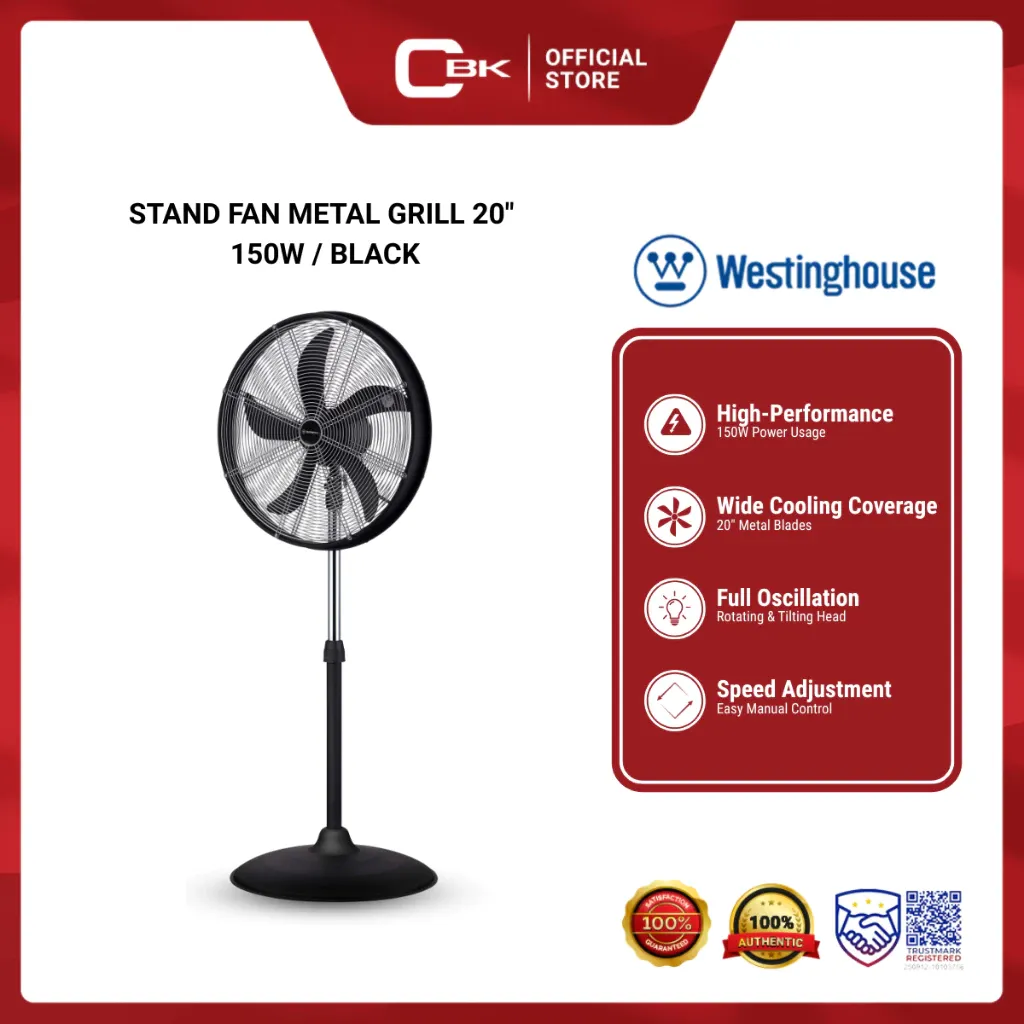
Westinghouse Stand Fan 20" Industrial Heavy-Duty Electric Fan WH72715
₱6,400as of Aug 27, 2026
COD · Shopee-protected payment

How we reviewed this: we read the Shopee PH listing, checked the listed specs, and went through 589 owner ratings.
Westinghouse Stand Fan 20" Industrial Heavy-Duty Electric Fan WH72715Our Best for large spaces pick: a 20-inch, 150W industrial fan with a metal grill and a permanently oiled motor, at around ₱6,400. The catch is 75 dBA of noise and a running cost four times a DC fan's.
₱6,400as of Aug 27, 2026
COD · Shopee-protected payment
| Brand | Westinghouse |
|---|---|
| Type | Stand fan |
| Price | ₱6,400 (as of Aug 27, 2026) |
| Shopee owner rating | 4.9 ★ from 589 Shopee ratings |
| Shop | CBK Hardware |
| Units sold | 1K+ |
Specs per Westinghouse WH72715 retailer listings
| Type | Stand fan |
|---|---|
| Motor type | AC, permanently oiled |
| Wattage | 150W |
| Blade size | 20in |
| Blade material | ABS, metal grill |
| Speeds | 3-speed |
| Max speed | 1,250 rpm |
| Noise level | 75 dBA |
| Voltage | 220V |
| Controls | Manual, oscillating and tilting head |
The Westinghouse WH72715 is our Best for large spaces pick: a 20-inch, 150W industrial fan with a metal grill and a permanently oiled motor, at around ₱6,400.
Coverage that no 16-inch fan reaches. This is the largest blade in our roundup, spinning at 1,250 rpm on a 150W motor, and it is built to push air across a workshop or a covered court rather than at a person.
Westinghouse does not publish an m³/min figure, which is a gap worth naming. The best comparison we can offer honestly is that the 18-inch Asahi PF-830 publishes 78 m³/min on 100W, and a 20-inch blade on a 150W motor sits above that. But “sits above” is an inference, not a measurement, and you should treat it that way.
What is published is the noise: 75 dBA. That is loud enough that you raise your voice over it. In an industrial fan that is expected and forgivable. In a bedroom it is disqualifying.
Three speeds, manual controls, with an oscillating and tilting head.
Genuinely commercial, which is where the price goes. ABS blades behind a metal grill, a heavy frame, and a permanently oiled motor, meaning the bearings are sealed and lubricated at the factory so there is nothing to service over the fan’s life.
That last spec matters more than it sounds on a fan meant to run open hours in a shop or a garage. Older commercial fans needed periodic oiling and were killed by nobody doing it. This one removes the failure mode.
Height is adjustable and the head both oscillates and tilts, so you can aim it down a workbench or up into a covered space. The finish is silver and black, and it looks like equipment rather than furniture.
Controls are plain manual switches. No timer, no remote, and at 150W that omission costs real money if the fan gets left running.
Around ₱6,400 as of August 27, 2026. Check the latest price on Shopee. That makes it the second-most expensive fan in our roundup.
Running cost is the number to plan around: at 150W and eight hours a day it draws about 36 kWh a month, roughly ₱532 at around ₱14.78 per kWh (Meralco, August 2026). A 35W DC stand fan costs about ₱124 on the same schedule. Over a year the gap is roughly ₱4,900, which is more than the fan costs.
That arithmetic is not an argument against the fan, it is an argument about where to put it. In a workshop where it replaces three smaller fans, the maths works. In a home where a ₱2,500 16-inch fan would have done, it does not.
The 4.9 rating rests on 589 raters, a solid sample sold through CBK Hardware.
Buy this if you need to move air through a large space and noise is not a constraint. It is the right choice for a garage, a workshop, a covered court, a warehouse, or a commercial kitchen, and the permanently oiled motor means it will survive being ignored. If it is going anywhere someone sleeps or holds a conversation, buy an 18-inch fan instead and keep the 75 dBA out of the house.
If you want most of this air for less money and less noise, the Asahi PF-830 publishes 78 m³/min on 100W at around ₱3,500 and converts to a floor or wall fan. If the space is domestic after all, the Asahi PF-631 moves 71.6 m³/min at 65W for around ₱2,500.
See how it ranks against the rest in our best stand fans in the Philippines roundup, or size the blade to your space with our stand fan buying guide.
See how it compares with the other top picks in our stand fans comparison.
At 150W and eight hours a day, about 36 kWh a month, or roughly ₱532 at around ₱14.78 per kWh (Meralco, August 2026). That is more than four times what a 35W DC stand fan costs on the same schedule, and it is the price of a 20-inch blade.
For a bedroom or a sala, yes. It is rated at 75 dBA, which is loud enough that you raise your voice over it. That is normal for an industrial fan and it is the trade for the air a 20-inch blade moves. Buy it for a garage, a covered court, or a workshop.
The bearings are lubricated at the factory and sealed, so there is nothing for you to oil over the fan's life. On an industrial fan that runs long hours, that removes the main piece of routine maintenance an older commercial fan would need.
No. Retailer listings give 1,250 rpm, 150W, 75 dBA, and a 20-inch blade, but no m³/min number. The 18-inch Asahi PF-830, which does publish one, reaches 78 m³/min at 100W, so treat that as the floor rather than a direct comparison.
Every card links to our full review.
Disclosure: Product Choicest is reader-supported. We may earn a commission when you buy through our Shopee links, at no extra cost to you. Read affiliate disclosure.