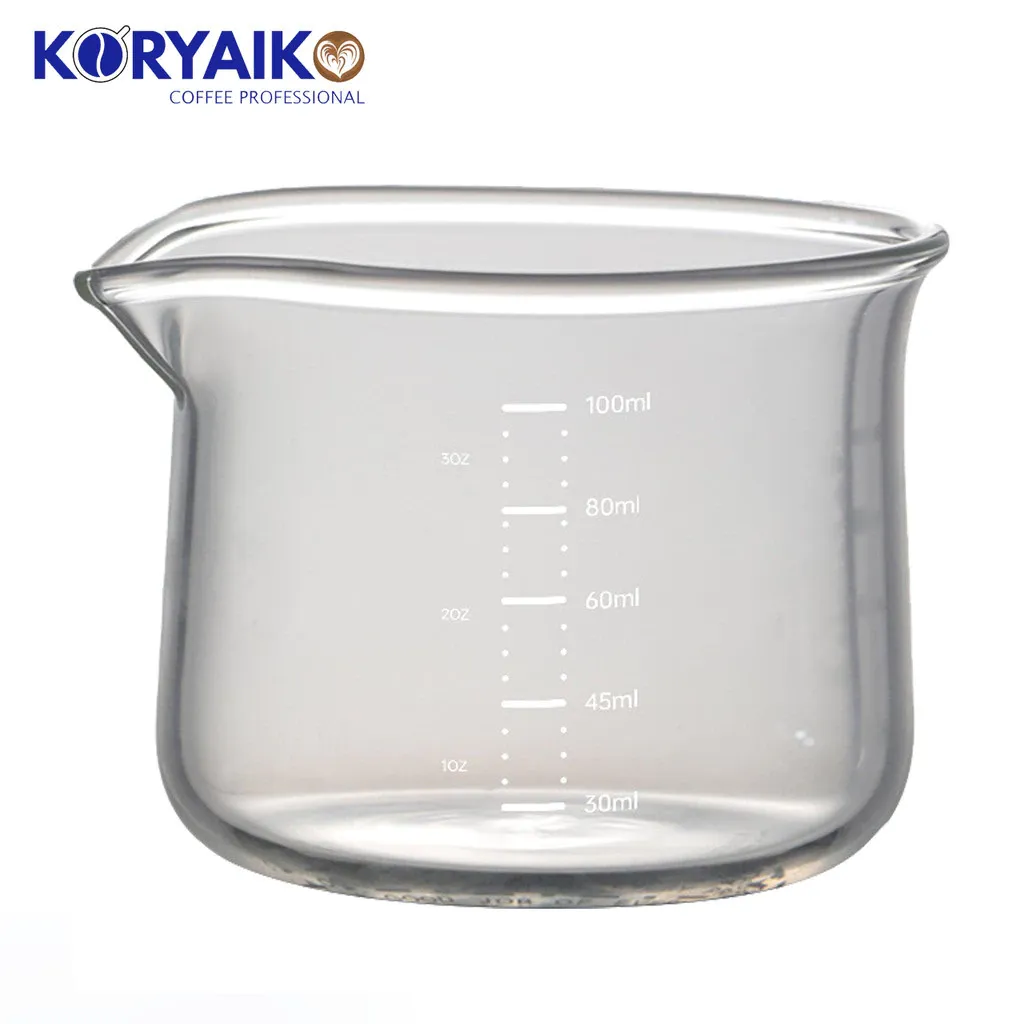
Koryaiko 100ml Borosilicate Espresso Measuring Cup
₱152as of Aug 19, 2026
COD · Shopee-protected payment

How we reviewed this: we read the Shopee PH listing, checked the listed specs, and went through 263 owner ratings.
Koryaiko 100ml Borosilicate Espresso Measuring CupA graduated shot glass for reading espresso yield, in the one material that will not object to something at 90 degrees landing in it.
₱152as of Aug 19, 2026
COD · Shopee-protected payment
| Brand | Koryaiko |
|---|---|
| Type | Espresso measuring cup |
| Price | ₱152 (as of Aug 19, 2026) |
| Shopee owner rating | 4.9 ★ from 263 Shopee ratings |
| Shop | Koryaiko Philippine |
| Units sold | 996 |
| Type | Espresso measuring cup |
|---|---|
| Material | Borosilicate glass |
| Capacity | 100ml |
A 100ml graduated glass at around ₱152 as of August 19, 2026, from a coffee-accessory brand. This is not a baking tool, and it is worth knowing what it is.
Espresso is defined by three numbers: how much dry coffee went in, how long the shot ran, and how much liquid came out. The last one is yield, and it is the number a shot glass shows you.
A standard double runs somewhere around 36 to 40g of liquid out of an 18g dose. Pull less and you get a ristretto, thicker and sharper. Pull more and you get a longer, thinner shot. Being able to see where the flow has reached, while it is running, is how you learn to stop it in the right place.
At 100ml this holds a double comfortably with room to see it arrive.
Here is the honest limitation. Espresso comes out with crema on top, and crema is foam. It settles over the first minute, so the level you read at the end of the shot is not the level you read a minute later.
Weight does not do that. A small scale under the cup gives you a repeatable number, which is why most people who care about yield weigh rather than measure.
So a graduated glass is the visual, in-the-moment version: good for learning where your shots land and for spotting a run that is going long, less good as the number you record.
Espresso leaves the machine at around 90 degrees and lands in a cup that has been sitting at room temperature. Ordinary soda-lime glass expands as it heats, and a fast temperature jump stresses it.
Borosilicate barely expands, which is why it is the material for anything that meets hot liquid suddenly. For a cup whose entire job is catching something very hot, it is not a premium feature, it is the specification.
Around ₱152 makes this the cheapest of the three Koryaiko cups on this page and a fraction of the MHW-3BOMBER 100ml stainless cup at around ₱580 for the same capacity.
The stainless cups cannot show you the shot at all, which for this particular job is a real difference rather than a matter of taste.
Buy this if you pull espresso at home, you want to see yield while the shot runs, and you would rather not spend on stainless you cannot see through.
Skip it if you already weigh your shots, or if you wanted a measuring cup for cooking.
For a heat-insulated handle, see the Koryaiko 120ml cup with wooden handle. For measuring liquids in cooking rather than coffee, the Eurochef 250ml borosilicate jug is the kitchen equivalent.
See how it compares with the other top picks in our measuring cups comparison.
Yield is one of the three numbers that define a shot, alongside dose and time. Watching where the flow reaches tells you whether you pulled a ristretto, a normale or a long shot.
No. Crema sits on top and settles over the first minute, so a volume reading changes as you watch it. A scale under the cup is the more repeatable measurement.
Espresso leaves the group head at around 90 degrees into a cup that is often at room temperature. Borosilicate expands very little when heated, so that temperature jump does not stress the glass.
Every card links to our full review.
Disclosure: Product Choicest is reader-supported. We may earn a commission when you buy through our Shopee links, at no extra cost to you. Read affiliate disclosure.