
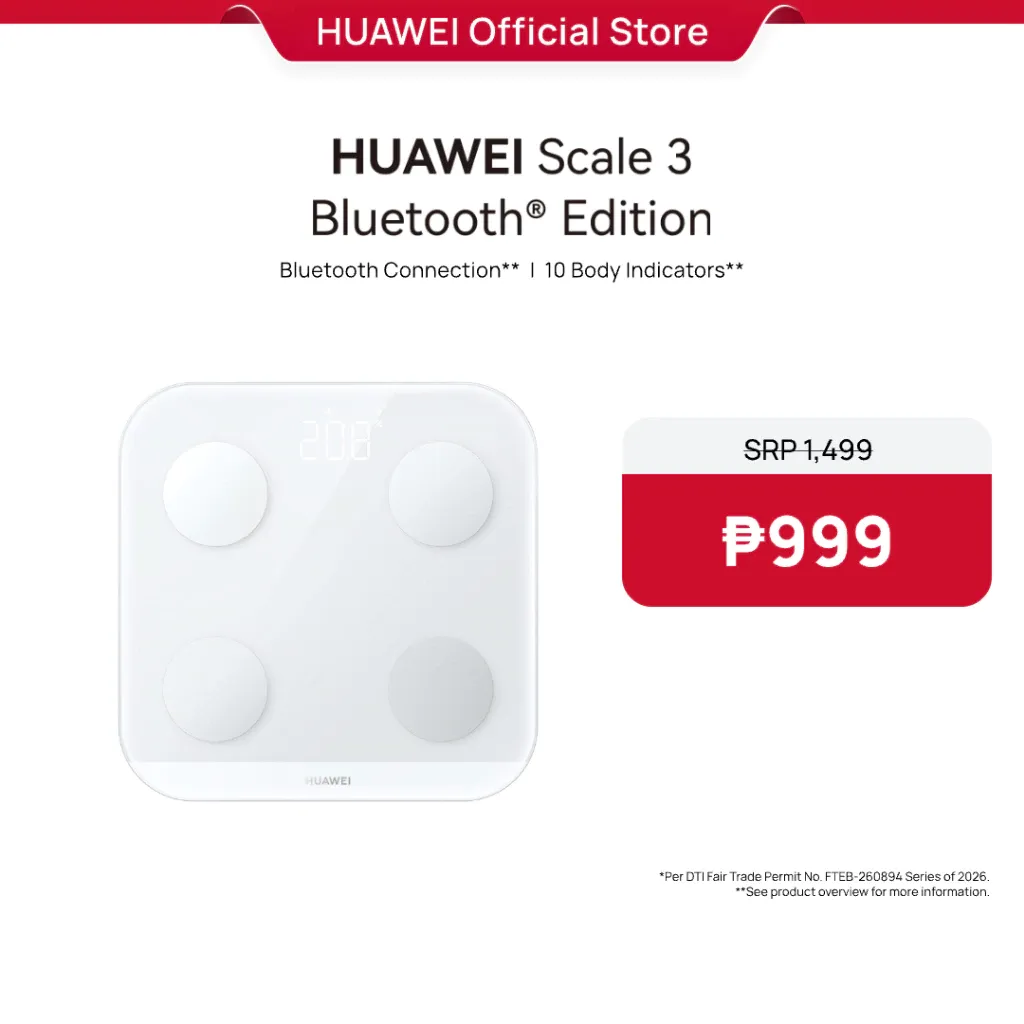
Huawei Scale 3 vs Xiaomi Scale S400
Buy the Huawei Scale 3 if you want your body-fat number on the scale itself, without picking up your phone. Buy the Xiaomi S400 if you are actually tracking body composition and you already run Xiaomi Home.
The Huawei Scale 3 ranks higher in our body scales roundup. On value, the Huawei Scale 3 costs less (₱899 vs ₱1,000), and both share a 4.9★ owner rating.
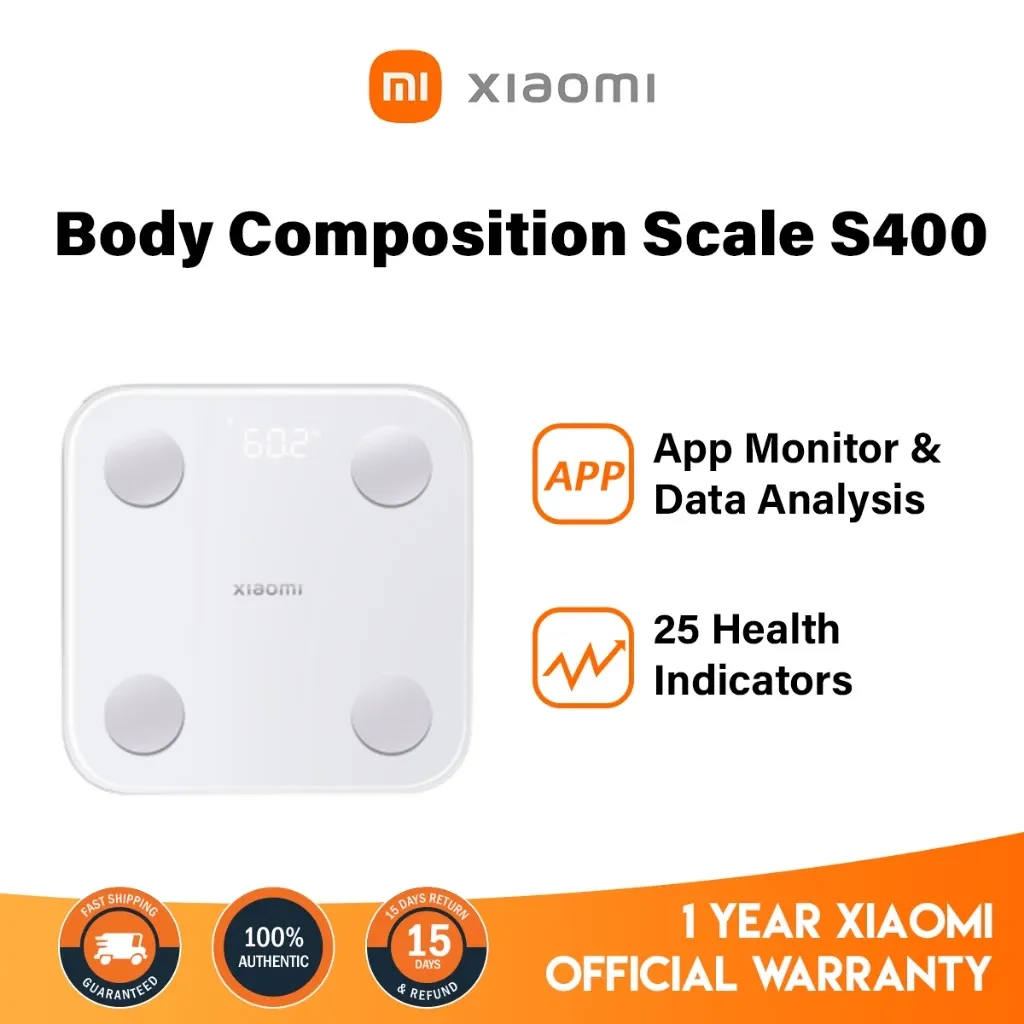
Spec-by-spec
| Spec | Huawei Scale 3 | Xiaomi Scale S400 |
|---|---|---|
| Shopee rating | 4.9★ | 4.9★ |
| Price | ₱899 | ₱1,000 |
| Type | Smart body-fat scale | Smart body-fat scale |
| Measurements | 10-indicator body composition | 25 health indicators |
| Graduation | 0.05kg (senses from 0.1kg) | 0.1kg |
| Connectivity | Bluetooth | Bluetooth 5.0 |
| App | Huawei Health | Xiaomi Home |
| Users | Up to 10 Huawei IDs | – |
| Offline | Shows body fat without the app | – |
| Model | – | S400 |
| Weighing range | – | 0.1–150kg |
| Battery | – | Up to 180 days (3 AAA) |
These are the two smart scales Filipino shoppers ask us to separate most often, and the honest answer is that they are built for two different people. One is a scale that happens to be smart. The other is a body-composition tool that happens to weigh you.
How many measurements do you actually need?
The Huawei reports 10 body-composition indicators. The S400 reports 25. That gap sounds decisive and mostly is not, because the first five (weight, BMI, body fat, muscle, water) are the ones anybody checks twice. The rest are for a person with a goal: cutting, bulking, or tracking visceral fat on a doctor’s advice.
Where the S400 genuinely pulls ahead is how it measures. It uses dual-frequency sensing rather than a single frequency, which is the technical reason it can separate muscle from water with more confidence, and Xiaomi publishes a benchmark against a DEXA scan. If body composition is the reason you are buying a scale at all, that is the one spec on this page worth paying for.
If you want to know what you weigh and roughly where your body fat sits, the Huawei covers it, and covers it in finer steps: it reads to 0.05kg where the S400 reads to 0.1kg.
Does it work without the app?
This is the difference that decides most of these purchases, and it is easy to miss on a spec sheet.
The Huawei shows a body-fat reading on the scale itself. Step on, look down, done. The S400 shows your weight and keeps everything else in Xiaomi Home.
That matters more in a Filipino household than it sounds. A bathroom scale is shared. Lola is not installing Xiaomi Home. A visiting cousin is not logging in. On the Huawei, everyone who steps on it gets something useful; on the S400, everyone who has not set up the app gets a weight and nothing else.
Which phone are you already on?
Both scales lock their full feature set to one app, so the deciding question is often just which ecosystem you already live in.
- Huawei Health is the Huawei’s only route. It runs on Android and iOS, so a non-Huawei phone is fine, but you are adding one more health app to your phone.
- Xiaomi Home is the S400’s only route, and it is the same app that runs Xiaomi lights, purifiers and dehumidifiers. If you already have that app open weekly, the S400 slots in with no new login.
Neither exports to Apple Health or Google Fit as cleanly as the marketing implies, so treat the app you pick as the place your data lives.
Who should skip both?
If you only want to know your weight, both of these are more scale than you need, and the roundup’s budget pick will do the job for a fraction of the money. Body-composition sensing is also off the table if you have a pacemaker or other implanted device, or if you are pregnant. In that case buy a plain digital scale and skip the smart features entirely.
Read the full Huawei Scale 3 review or the Xiaomi S400 review, and see where both land in our best body scales in the Philippines ranking.
Which should you buy?
- Choose the Huawei Scale 3 if it ranks higher in our roundup, and it costs less (₱899).
- Choose the Xiaomi Scale S400 if its specs below suit your needs better.
Prices shown above were ₱899 and ₱1,000 when we last checked. Shopee is the live source.
Frequently Asked Questions
Which is more accurate, the Huawei Scale 3 or the Xiaomi S400?
For plain weight, the Huawei reads in finer steps (0.05kg against the S400's 0.1kg). For body composition the S400 is the stronger tool: it uses dual-frequency sensing and Xiaomi benchmarks it against a DEXA scan. Neither is a medical device. Both estimate body fat by passing a tiny current through your feet, which is good for spotting a trend over weeks, not for a one-off number you can quote to a doctor.
Do you need the app to use either scale?
You need it to see everything, but not to see something. The Huawei Scale 3 shows weight and a body-fat reading on the scale display with your phone still in another room, which is the single biggest practical difference between these two. The S400 shows weight on the scale and keeps the other 24 indicators in Xiaomi Home.
Can the whole family use one scale?
Yes, and both handle it, but differently. The Huawei supports up to 10 Huawei IDs. The S400 separates users inside Xiaomi Home. In a house where not everyone will install an app, the Huawei is the easier sell, because a guest can still step on it and get a reading.
Is a body-fat scale safe for everyone?
No. Neither scale should be used for body-fat sensing if you have a pacemaker or another implanted electronic device, or if you are pregnant. Both will still weigh you safely. Huawei also rates its body-fat reading for ages 18 to 65 only, so a child's composition figure on it means nothing.
See both ranked in our Best body scales in the Philippines (2026), or compare other body scales. Read the Huawei Scale 3 review. Read the Xiaomi Scale S400 review.
Disclosure: Product Choicest is reader-supported. We may earn a commission when you buy through our Shopee links, at no extra cost to you. Read affiliate disclosure.