
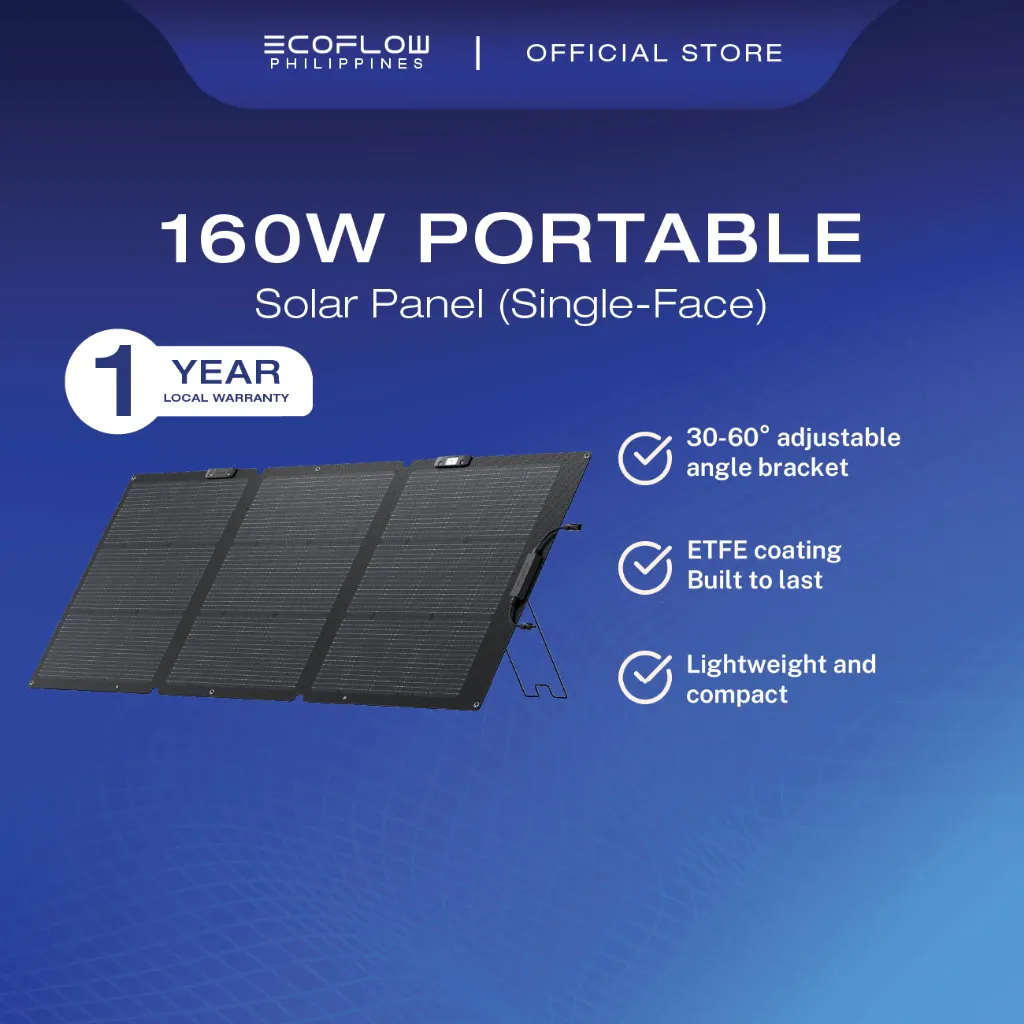
EcoFlow 160W portable solar panel review
How we reviewed this: we read the Shopee PH listing, checked the listed specs, and went through the owner reviews.
EcoFlow 160W Portable Solar PanelA solid 160W folding panel with a kickstand case for around ₱17,000, but the older IP67 rating and 7kg weight leave it behind newer panels here.
- Price: ₱17,000 as of Aug 2, 2026
- Biggest pro: One-piece foldable design with a kickstand case included
- Main catch: IP67 rather than the IP68 on EcoFlow's newer panels, so it is rated for less water exposure
At a glance
| Brand | EcoFlow |
|---|---|
| Type | Solar panel |
| Price | ₱17,000 (as of Aug 2, 2026) |
| Shopee owner rating | 4.9 ★ from 21 Shopee ratings |
| Shop | EcoFlow Philippines · Shopee Mall ✓ |
| Units sold | 36 |
Specifications
Specs per EcoFlow
| Type | Solar panel |
|---|---|
| Rated power | 160 W |
| Cell type | Monocrystalline silicon |
| Efficiency | 21-22% |
| Weight | 7 kg |
| Water resistance | IP67 |
| Film | 0.2 mm ETFE, UV protective |
| Connector | MC4 |
Pros and cons
✓ Pros
- One-piece foldable design with a kickstand case included
- 0.2mm ETFE film protects the cells from UV and extends panel life
- Universal MC4 connector, so it pairs with non-EcoFlow power stations
- 160W refills a mid-size power station in a single sunny day
- Sold through EcoFlow's own Philippine Shopee store
✗ Cons
- IP67 rather than the IP68 on EcoFlow's newer panels, so it is rated for less water exposure
- 21-22% efficiency, below the 25% TOPCon panels in this roundup
- 7kg for 160W, heavier than the 4.2kg 125W Bifacial panel
- Costs more per watt than the 125W Bifacial while giving up efficiency and weight
The EcoFlow 160W is a solid but older folding panel: 160W with a kickstand case for around ₱17,000. It works well, and newer panels in EcoFlow’s own range have moved past it.
What does it do well?
The basics, properly. A one-piece foldable design with the kickstand built into the case, a universal MC4 connector that works with non-EcoFlow gear, and a 0.2mm ETFE film over the cells that blocks UV and adds years to the panel’s life.
At 160W it refills a mid-size power station in a single sunny day, which is the useful bracket for most Filipino households: enough to matter, not so much that your battery cannot take it.
Where does it fall behind?
Three places, and they all come from age.
- Efficiency is 21-22%, against the 25% that the TOPCon cells in the 125W Bifacial and 220W Lightweight reach.
- The rating is IP67, not the IP68 on EcoFlow’s newer panels. In practice IP67 is plenty for rain, but it is the older standard.
- It weighs 7kg, where the 125W Bifacial does 4.2kg and the 220W Lightweight does 4.4kg with far more output.
None of that makes it a bad panel. It makes it a previous-generation panel still selling at a current-generation price.
Is this solar panel sulit?
Around ₱17,000 as of August 2, 2026. Check the latest price on Shopee. That is roughly ₱106 per watt, against ₱72 for the 125W Bifacial, which is lighter, more efficient, and better sealed.
The one place this panel still argues its case is the MC4 connector. If you already own a charge controller or a non-EcoFlow power station, plugging straight in without an adapter has real value, and the 125W’s XT60-W plug does not give you that.
Sold through EcoFlow’s own Philippine Shopee store.
Who this solar panel suits
Buy this if you need MC4 compatibility with gear you already own and want a folding panel around 160W. It is a fair choice for an existing off-grid setup. If you are starting fresh, the newer panels in this roundup give you more for less. See how it ranks in our best solar panels in the Philippines roundup, or browse more on our Home Improvement page. Our solar panel buying guide explains connectors and efficiency ratings.
Other solar panel options to compare
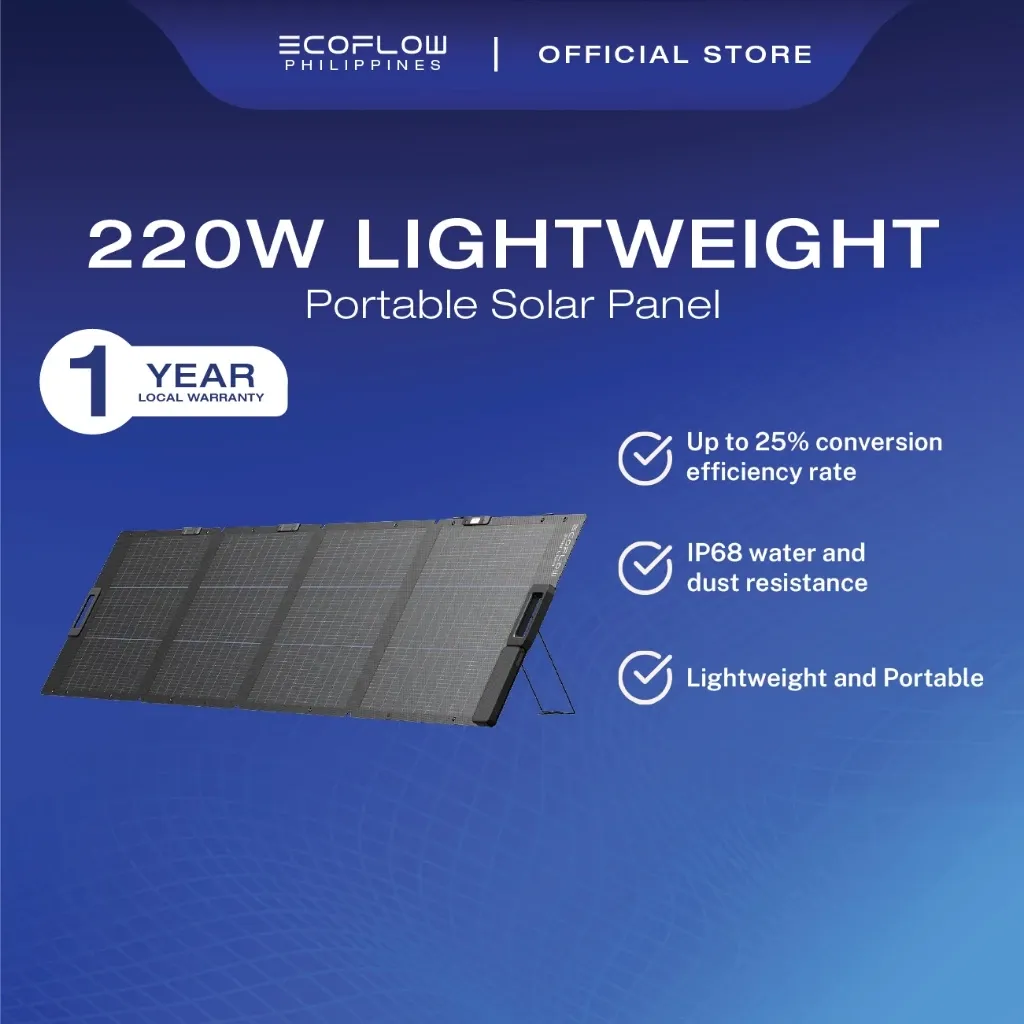
For better value in every measurable way, the EcoFlow 125W Bifacial is our Best Overall at around ₱9,000, lighter and more efficient. If you want more output at a similar weight, the EcoFlow 220W Lightweight does 220W at 4.4kg for around ₱22,000.
Frequently Asked Questions
How is this different from the newer EcoFlow panels?
It is an older generation. The 160W is rated IP67 at 21-22% efficiency and weighs 7kg, where the newer 125W and 220W panels use TOPCon cells at up to 25%, carry IP68, and weigh 4.2kg and 4.4kg. You are buying a previous-generation panel at a current-generation price.
Is IP67 enough for Philippine rain?
For most uses, yes. IP67 means it survives being briefly submerged in shallow water, so an afternoon downpour is not a problem. IP68 goes further and covers sustained submersion, which is more than a solar panel usually needs.
Does the MC4 connector matter?
It helps. MC4 is the universal solar standard, so this panel plugs into non-EcoFlow power stations and charge controllers without an adapter. Some of EcoFlow's newer panels use XT60 instead, which needs one.
What is the ETFE film for?
The 0.2mm ETFE layer over the cells blocks ultraviolet light, which is what degrades a panel over years of sun. It is a genuine longevity feature rather than marketing, and it is the reason this panel survives being left outdoors.
More solar panels we've reviewed
Every card links to our full review.
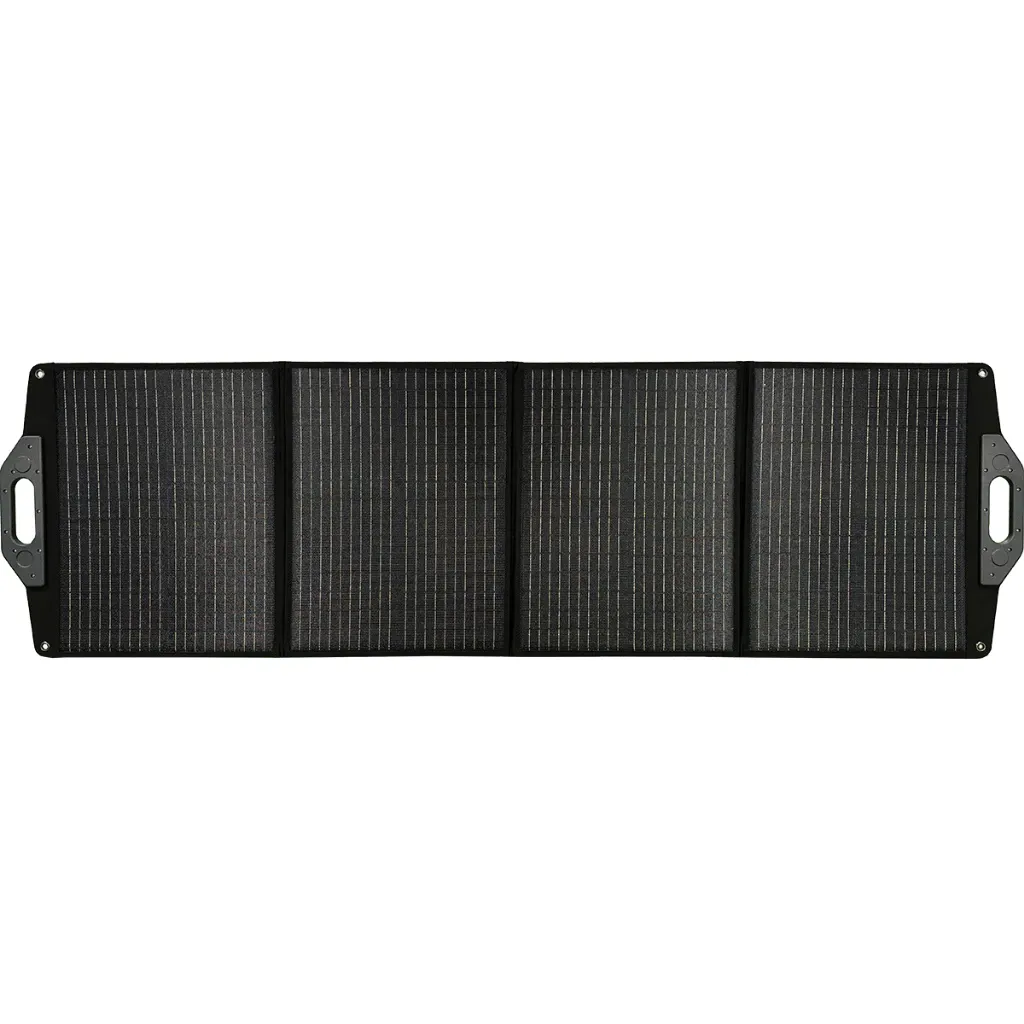
Firefly Monocrystalline Solar Panel FSP120/18
₱13,500as of Aug 2, 2026
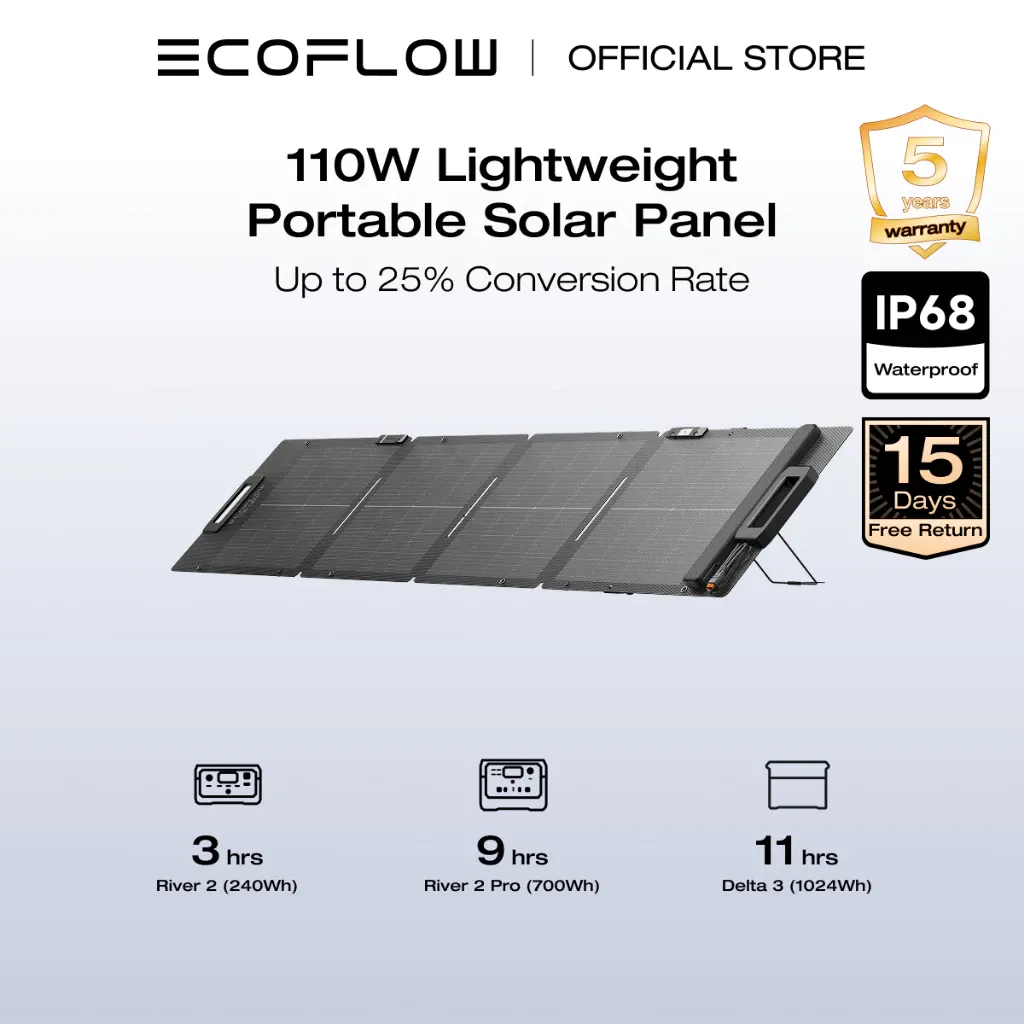
EcoFlow 110W Portable Solar Panel Kit
₱15,000as of Aug 2, 2026
Disclosure: Product Choicest is reader-supported. We may earn a commission when you buy through our Shopee links, at no extra cost to you. Read affiliate disclosure.
EcoFlow 160W Portable Solar Panel₱17,000 when last checked
See today's price 🛒