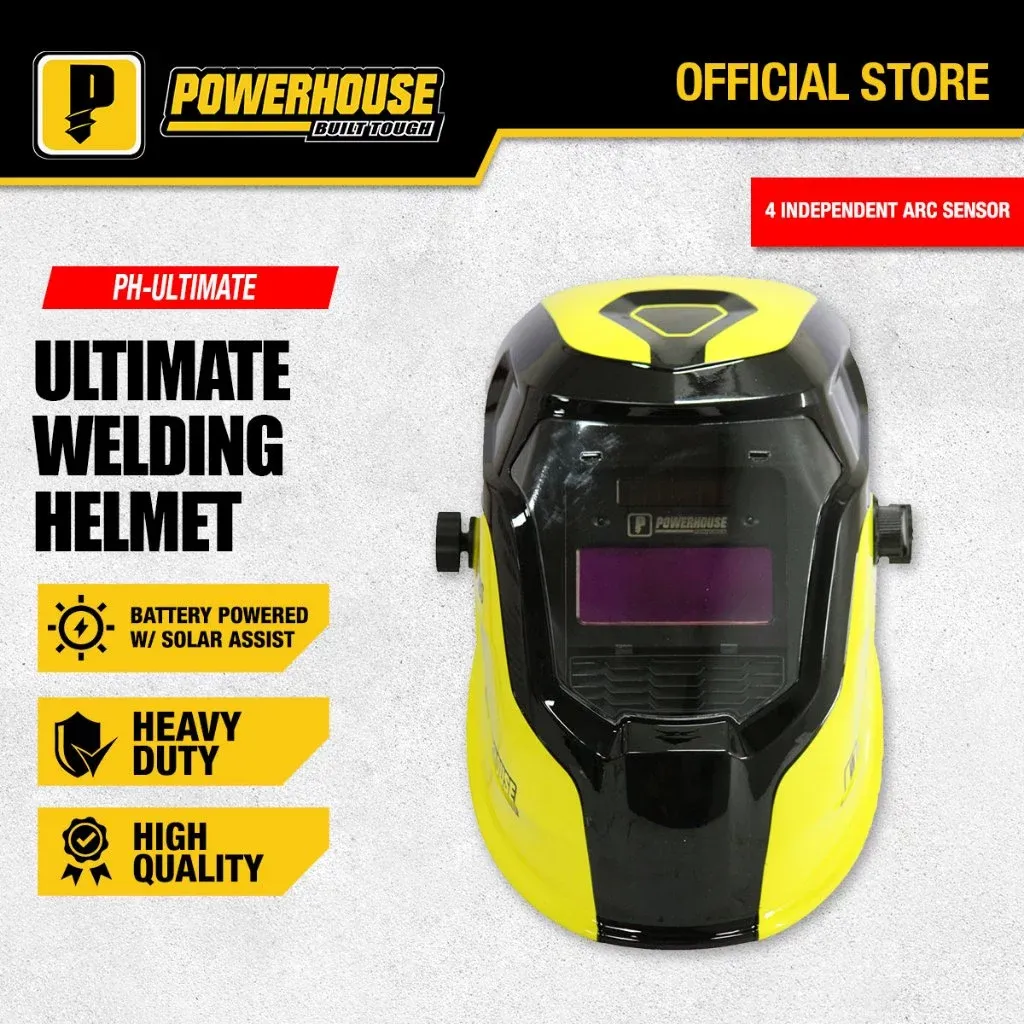
POWERHOUSE Ultimate Series Auto-Darkening Welding Helmet
₱2,400as of Aug 16, 2026
COD · Shopee-protected payment

Disclosure: Product Choicest is reader-supported. We may earn a commission when you buy through our Shopee links, at no extra cost to you. Read affiliate disclosure.
Full-face coverage and solar with battery assist from a flagship store, but Powerhouse publishes no shade range, so the key specification is unknown.
₱2,400as of Aug 16, 2026
COD · Shopee-protected payment
| Brand | Powerhouse |
|---|---|
| Type | Welding helmet |
| Price | ₱2,400 (as of Aug 16, 2026) |
| Owner rating | 4.9 ★ from 282 reviews |
| Shop | Powerhouse Flagship Store |
| Units sold | 659 |
Specs per Powerhouse Philippines published data for the Ultimate Series helmet
| Type | Welding helmet |
|---|---|
| Coverage | Full face protection |
| Arc sensors | Dual arc sensor |
| Power | Solar with battery assist |
| Shade control | Not specified |
| Switching time | Not specified |
| Viewing area | Not specified |
The Powerhouse Ultimate Series has full-face coverage and solar with battery assist for around ₱2,400. What it does not have is a published shade range.
Full face protection, meaning the shell extends down over the jaw and throat rather than stopping at the chin. That is a genuine benefit: spatter and reflected UV coming from below are easy to underestimate, particularly on out-of-position work.
Dual arc sensors, which is more than the single sensor on the cheapest auto-darkening helmets, though less than the four found on premium models.
Solar with battery assist. The solar cell charges from the arc and ambient light while an internal battery covers the gaps, so the lens triggers reliably even in a dim corner. It is the more robust of the two common power arrangements.
It is sold by the Powerhouse Flagship Store, which is the authoritative listing for warranty and returns.
No shade range. No light state. No switching time. No viewing area. No filter cartridge size. No UV and IR rating.
The shade range is the one that matters. It is the single specification that decides what a helmet can be used for. A variable DIN 9-13 lens follows you from TIG to heavy stick; a fixed shade 11 lens handles general stick and little else.
Without it, you cannot answer the basic question of whether this helmet suits your machine and your work. In a product whose job is protecting your eyes, leaving that out is a strange decision.
The missing UV/IR rating compounds it. That is the protection that works even when the electronics fail, and every well-specified helmet in this comparison publishes DIN 16.
Around ₱2,400 as of August 16, 2026, the most expensive helmet in our roundup. Check the latest price on Shopee.
Hard to recommend at that price against helmets that tell you what they do. The Tolsen 45087 costs meaningfully less and publishes a variable DIN 9-13 shade, a 92 x 42 mm window, adjustable sensitivity and delay, and its switching time.
The full-face shell is a real advantage, and if you ask the seller for the shade range and get a reliable answer, this may well be a good helmet. Buying it without that answer is not something we would advise.
Buy this if full-face coverage is your priority and you have confirmed the shade range with the seller first. Otherwise choose a helmet that publishes its specification. See how it ranks in our best welding helmets in the Philippines roundup, or browse more on our Home Improvement page. Our welding helmet buying guide explains which specs to insist on.
The Tolsen 45087 costs less and publishes everything this one does not, including a variable DIN 9-13 shade and the largest viewing window here. For much less again, the Lotus LTWH300 gives you a documented variable shade range and an adjustable delay.
Because it is the single thing that decides what welding a helmet suits. A variable DIN 9-13 lens covers TIG through heavy stick; a fixed shade 11 lens covers general stick and little else. Without knowing which this is, you cannot tell whether it fits your machine and your work.
It is a real benefit. A full-face shell extends down over the jaw and throat rather than stopping at the chin, which protects against spatter and reflected UV from below. On overhead or out-of-position welding that reflected exposure is easy to underestimate.
The solar cell charges from the arc and ambient light while an internal battery covers the gaps, so the helmet triggers reliably in a dim corner where a solar-only design might be sluggish. It is the more robust of the two common power arrangements.
Only if you ask the seller for the shade range first and get an answer you can rely on. It is the most expensive helmet in our roundup and the least documented, which is an uncomfortable combination in a safety product. There are well-specified helmets here for less.
Every card links to our full review.
₱1,300as of Aug 16, 2026
₱1,500as of Aug 16, 2026
₱1,600as of Aug 16, 2026