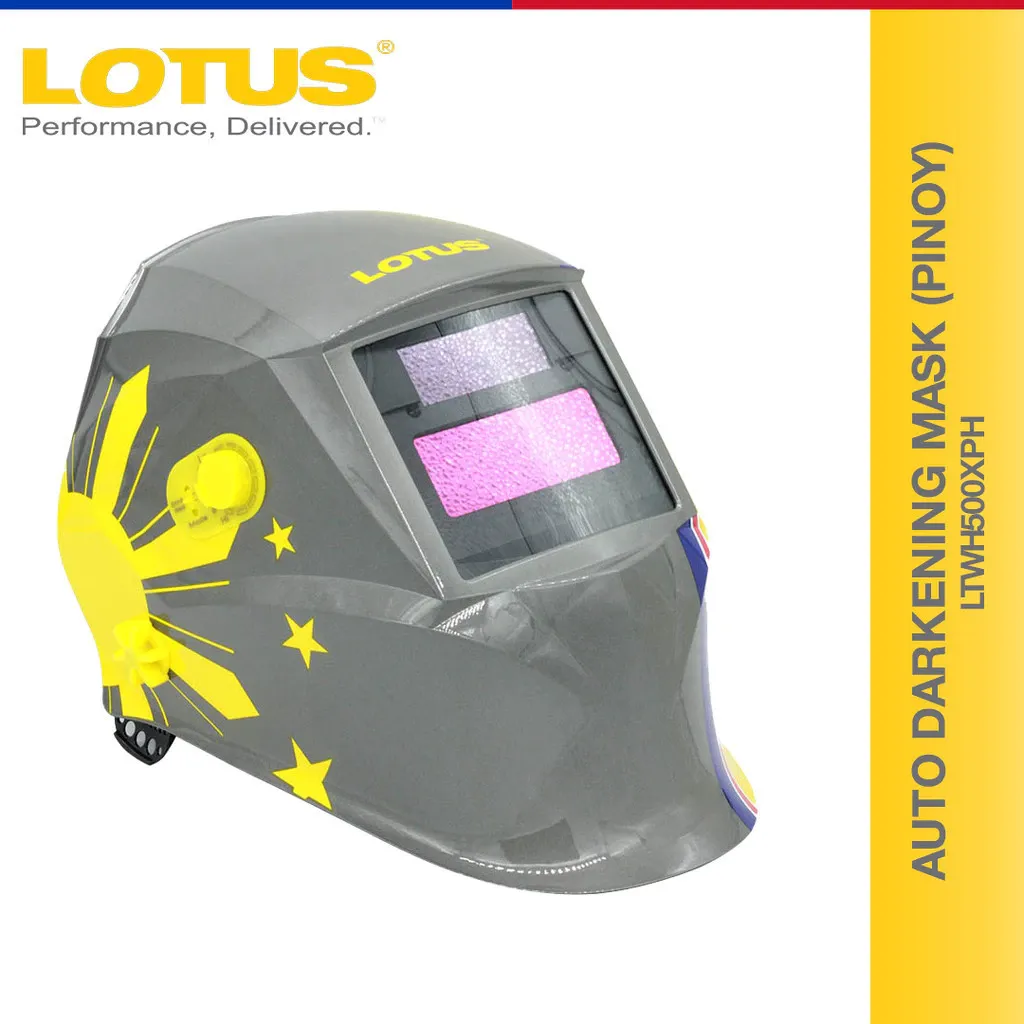
Lotus LTWH500XPH Pinoy Auto Darkening Welding Mask
₱1,600as of Aug 16, 2026
COD · Shopee-protected payment

Disclosure: Product Choicest is reader-supported. We may earn a commission when you buy through our Shopee links, at no extra cost to you. Read affiliate disclosure.
Our Best Upgrade Pick: variable DIN 9-13 with adjustable sensitivity in a tougher polyamide shell, though a cheaper sibling matches its shade range.
₱1,600as of Aug 16, 2026
COD · Shopee-protected payment
| Brand | Lotus |
|---|---|
| Type | Welding helmet |
| Price | ₱1,600 (as of Aug 16, 2026) |
| Owner rating | 4.8 ★ from 78 reviews |
| Shop | Lotus® |
| Units sold | 170 |
Specs per Lotus Philippines published data for the LTWH500XPH
| Type | Welding helmet |
|---|---|
| Shade control | Variable, DIN 9-13 |
| Light state | DIN 4 |
| Arc sensors | 2 |
| Sensitivity | Adjustable |
| Power | Solar powered |
| Shell | High-impact polyamide |
The Lotus LTWH500XPH Pinoy is our Best Upgrade Pick: variable DIN 9-13 with adjustable sensitivity in a tougher polyamide shell, for around ₱1,600.
Variable DIN 9-13 shade from a DIN 4 light state, which is the feature that decides what a helmet can weld. TIG at the light end, heavy stick at the dark end, and everything between.
Adjustable sensitivity, which sets how strong an arc must be before the lens darkens. Turn it up for low-amp TIG where a weak arc might not register; turn it down if shop fluorescents or a neighbour’s arc make it flicker while you are idle. It is one of the two controls that separate a good helmet from a basic one.
Two arc sensors for reliable triggering when your hand or the workpiece blocks the line of sight.
A high-impact polyamide shell. Nylon is tougher and more heat resistant than the polypropylene used on cheaper helmets, which on a mask that gets dropped and knocked around a workshop is a genuine durability advantage.
Solar powered, so there is no battery to find flat.
Lotus sells the LTWH300 Ironman in the same range, and it publishes the same variable DIN 9-13 shade span, the same DIN 4 light state, and the same two arc sensors, for considerably less money.
The LTWH500XPH answers with adjustable sensitivity and the polyamide shell. The LTWH300 answers with an adjustable delay and a published filter size and viewing area.
Neither is clearly the better helmet on paper, which makes the price gap hard to explain.
Switching time, viewing area, delay range, and filter cartridge size are all unstated.
The last one has a practical cost. Auto-darkening cartridges are replaceable, and knowing the size is how you buy one. The cheaper sibling publishes both its filter dimensions and its viewing area; this does not.
Around ₱1,600 as of August 16, 2026. Check the latest price on Shopee.
It is a good helmet with the two most important features. The difficulty is that the same range offers the same shade control for much less, and the Tolsen 45087 at a similar price adds a larger published window, an external shade knob, and adjustable sensitivity and delay together.
Buy it for the polyamide shell and the Lotus service network, not because the lens does more.
Buy this if you want Lotus local support with a tougher shell and adjustable sensitivity, and the extra over the LTWH300 is not a concern. Otherwise the cheaper sibling covers the same welding. See how it ranks in our best welding helmets in the Philippines roundup, or browse more on our Home Improvement page. Our welding helmet buying guide explains what each control does.
The Lotus LTWH300 offers the same DIN 9-13 shade range and an adjustable delay for considerably less, with its viewing area and filter size published. At a similar price to this, the Tolsen 45087 gives you the largest window here plus adjustable shade, sensitivity, and delay together.
See how it compares with the other top picks in our welding helmets comparison.
The LTWH300 adjusts the delay, this adjusts how strong an arc must be to trigger the lens. Turn it up for low-amp TIG where a weak arc might not register; turn it down if shop lights cause flicker. It is a genuinely useful control, though only one of the two helmets publishes each.
Yes, meaningfully. Polyamide, which is nylon, is tougher and more resistant to heat and impact than the polypropylene used on cheaper helmets. On a mask that gets dropped, knocked, and sits near hot metal, that is a real durability advantage rather than a marketing claim.
It is the Philippine-market version of the LTWH500, sold with local branding. The specification follows the LTWH500 line; the difference is the market and the shell graphics rather than the lens.
Switching time, viewing area, delay range, and the filter cartridge size. That last one matters practically: without it, sourcing a replacement lens later is harder. The cheaper LTWH300 in the same range publishes both its filter size and its viewing area.
Every card links to our full review.
₱1,300as of Aug 16, 2026
₱1,500as of Aug 16, 2026