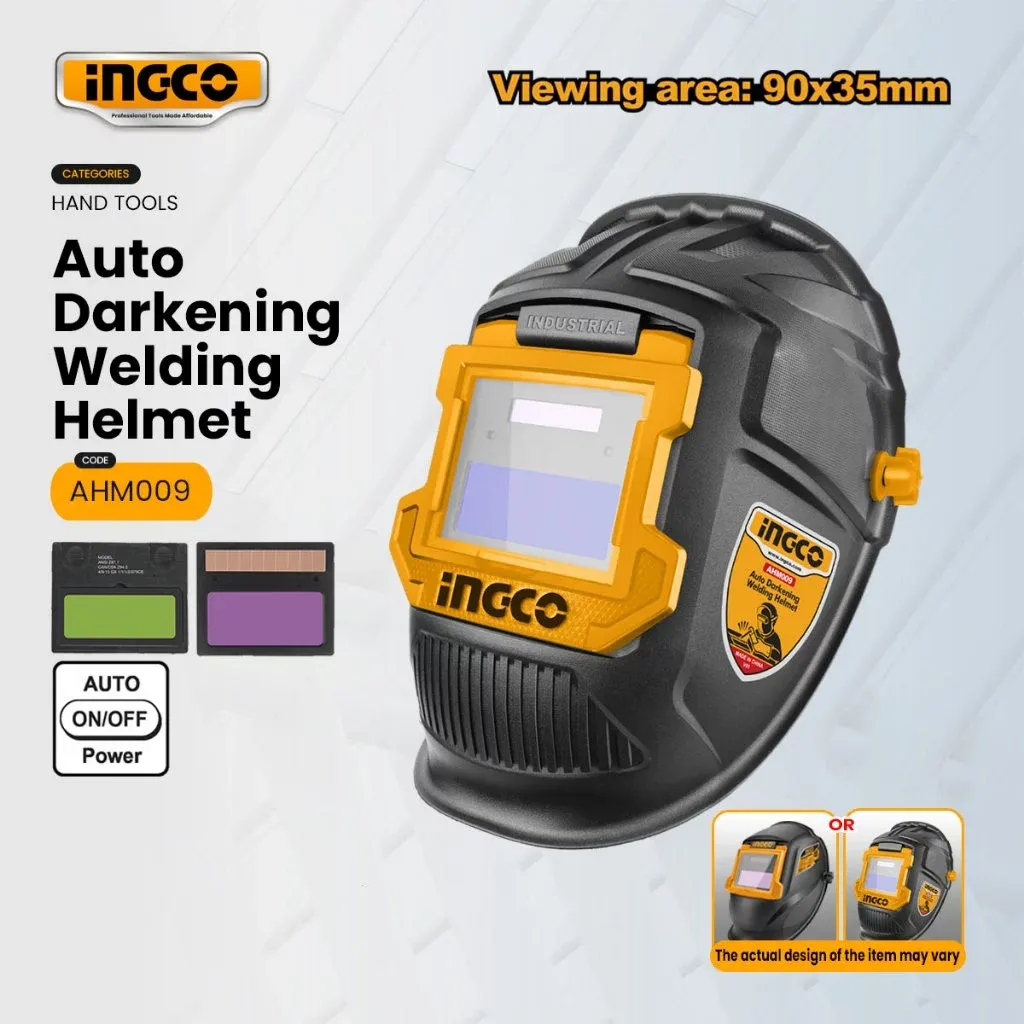
INGCO AHM009 Auto Darkening Welding Helmet Solar Powered
₱1,300as of Aug 16, 2026
COD · Shopee-protected payment

Disclosure: Product Choicest is reader-supported. We may earn a commission when you buy through our Shopee links, at no extra cost to you. Read affiliate disclosure.
Our Best for Stick Welding pick: fixed shade 11 is exactly right for general stick work, and it is the only helmet here with a replaceable battery.
₱1,300as of Aug 16, 2026
COD · Shopee-protected payment
| Brand | INGCO |
|---|---|
| Type | Welding helmet |
| Price | ₱1,300 (as of Aug 16, 2026) |
| Owner rating | 4.9 ★ from 2,294 reviews |
| Shop | ingco |
| Units sold | 5K+ |
Specs per INGCO published data for the AHM009
| Type | Welding helmet |
|---|---|
| Shade control | Fixed shade 11, unadjustable |
| Light state | DIN 4 |
| UV/IR protection | DIN 16 |
| Switching time | 1/5000 s |
| Delay | Dark to light 0.15-0.45 s, automatic |
| Arc sensors | 2 |
| Filter size | 110 x 90 x 10 mm |
| Viewing area | 90 x 35 mm |
| Power | Solar cells and 1 x CR2032 lithium battery |
| Shell | Polypropylene |
| Low amperage TIG | 20 A DC, 20 A AC |
| Operating temperature | -5 to +55 C |
The INGCO AHM009 is our Best for Stick Welding pick: its fixed shade 11 is exactly right for general stick work, and it is the only helmet here with a replaceable battery.
Most of this comparison argues for variable shade, and for good reason. But shade 11 specifically is the correct shade for stick welding at roughly 100 to 200 A, which covers gates, grilles, brackets, and general fabrication.
If that is the only welding you do, a fixed shade 11 helmet has a genuine advantage: there is nothing to set wrong. No knob left on 13 from last week, no lens too light because you forgot to change it. It darkens correctly every time.
Where it fails is outside that band. Low-amp TIG needs a lighter lens to see the puddle; high-amp work needs a darker one. Neither is available, and the sensitivity is not adjustable either.
Nearly every auto-darkening helmet here runs on a sealed lithium cell. When it dies, the helmet dies with it.
The AHM009 uses solar cells plus a standard CR2032, the same coin cell as a car key or a bathroom scale. It costs very little and is sold everywhere. That single design decision turns a disposable product into one that stays serviceable for years.
The rest of the specification is complete and published: DIN 4 light state, DIN 16 UV and IR protection, a 0.15 to 0.45 s dark-to-light delay which is the quickest recovery here, two arc sensors, and a polypropylene shell rated from -5 to +55 C, which matters in a hot Philippine workshop.
1/5000 s switching is the slowest in this comparison, five times slower than the quickest. In practice this matters far less than it sounds: one five-thousandth of a second is faster than your eye reacts.
The 90 x 35 mm viewing area is small, and the 20 A TIG threshold is higher than the 15 A a rival manages, so very low-current TIG may be less reliable at triggering it.
Around ₱1,300 as of August 16, 2026. Check the latest price on Shopee.
It costs more than variable-shade helmets in this comparison, which is the awkward fact. What it offers in return is the replaceable cell, the fastest recovery delay here, a fully published specification, and INGCO dealer support across the Philippines.
If you weld stick and nothing else, and you want a helmet that outlives its battery, that is a coherent trade. If you want shade flexibility, it is not.
Buy this if you weld stick around 100 to 200 A, want the simplicity of a fixed correct shade, and value a battery you can replace yourself. See how it ranks in our best welding helmets in the Philippines roundup, or browse more on our Home Improvement page. Our welding helmet buying guide explains the shade numbers.
If you want shade flexibility for less money, the Lotus LTWH300 gives you a variable DIN 9-13 range and an adjustable delay. For a cheaper fixed-shade helmet that switches faster and triggers at lower TIG current, the Wadfow WWH2501 is the direct rival.
See how it stacks up against our top pick in the head-to-head Lotus LTWH300 Ironman Auto Darkening Welding Mask vs INGCO AHM009 Auto Darkening Welding Helmet Solar Powered, or browse the full welding helmets comparison.
Because most helmets here use a sealed lithium cell, so when it dies the whole helmet is finished. The AHM009 takes a standard CR2032 that costs very little and is sold everywhere. That turns a disposable product into one you can keep running for years.
It is the slowest here, five times slower than the quickest, but the honest answer is that it barely matters. One five-thousandth of a second is faster than your eye reacts and far faster than the arc reaches full brightness. Do not let this number drive your decision.
Anyone running stick welding around 100 to 200 A, which describes most gate, grille, and general fabrication work in Filipino homes and small shops. It is the single most useful shade if you only get one. It is the wrong choice if you TIG thin material or run high-amp heavy work.
Somewhat. It means the sensors reliably detect arcs from 20 A on both DC and AC TIG. That is fine for most TIG work but higher than the 15 A a rival here manages, so on very thin sheet at low current it may be less reliable at triggering.
Every card links to our full review.
₱1,500as of Aug 16, 2026
₱1,600as of Aug 16, 2026