
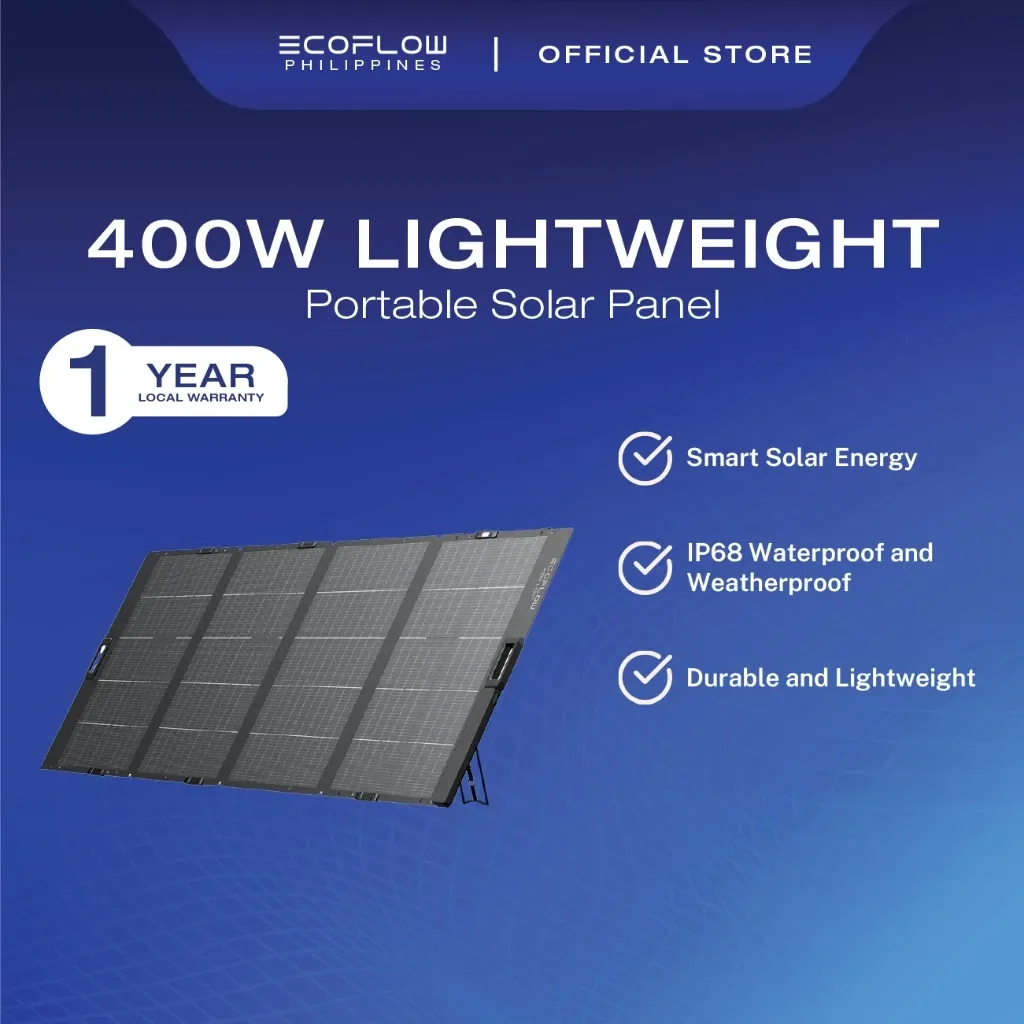
EcoFlow 400W portable solar panel review
How we reviewed this: we read the Shopee PH listing, checked the listed specs, and went through the owner reviews.
EcoFlow 400W Lightweight Portable Solar PanelOur Best Premium pick: 400W in one folding panel for around ₱35,000, the most output here, and only worth it with a big battery to absorb it.
- Price: ₱35,000 as of Aug 2, 2026
- Biggest pro: 400W is the most output of any single panel in this roundup
- Main catch: 400W is more than a small power station can take in, so it only pays off paired with a large battery
At a glance
| Brand | EcoFlow |
|---|---|
| Type | Solar panel |
| Price | ₱35,000 (as of Aug 2, 2026) |
| Shopee owner rating | 5.0 ★ from 15 Shopee ratings |
| Shop | EcoFlow Philippines · Shopee Mall ✓ |
| Units sold | 16 |
Specifications
Specs per EcoFlow's 400W portable panel; the Lightweight variant has no separate published sheet
| Type | Solar panel |
|---|---|
| Rated power | 400 W |
| Cell type | Monocrystalline silicon |
| Efficiency | 22.4% on EcoFlow's standard 400W panel |
| Water resistance | IP68 |
| Connector | MC4 |
| Form | Foldable, with an adjustable kickstand case |
Pros and cons
✓ Pros
- 400W is the most output of any single panel in this roundup
- Folds down for transport despite the size, unlike the rigid 400W panel
- IP68 rated for rain and dust
- Universal MC4 connector, so it works with non-EcoFlow gear too
- Sold through EcoFlow's own Philippine Shopee store
✗ Cons
- 400W is more than a small power station can take in, so it only pays off paired with a large battery
- Big and heavy even folded, so this is a car-boot panel rather than something you carry to a campsite
- EcoFlow publishes no separate spec sheet for the Lightweight variant, so the standard 400W figures are the closest reference
- Costs more per watt than the 125W Bifacial panel while needing far more space to set up
The EcoFlow 400W portable is our Best Premium pick: 400W in one folding panel for around ₱35,000. It is the most output of anything here, and it only makes sense if you own a battery big enough to take it.
What does 400W buy you?
Speed. A 400W panel refills a 1,000Wh power station in roughly three hours of good sun, where a 110W panel needs most of a day. If you run a large station through regular brownouts, that is the difference between being ready for tonight and being ready for tomorrow.
The cells are monocrystalline, rated at 22.4% on EcoFlow’s standard 400W panel, with an IP68 rating and a kickstand case included. The connector is MC4, the universal standard, so it feeds non-EcoFlow gear without an adapter. At this size that matters, because people buying 400W often already own a charge controller.
Who is it wrong for?
Anyone with a small power station. A 256Wh unit cannot accept 400W of input, so most of the panel does nothing. Matching the panel to the battery is the whole game here, and 400W is a lot of battery.
It is also big. It folds, which the rigid 400W does not, but folded it is still a two-hands, car-boot object rather than something you sling over a shoulder. Plan on a vehicle.
What is not documented?
One honest gap. EcoFlow publishes a complete sheet for its standard 400W portable panel, but not for the Lightweight variant this listing sells. We have used the standard panel’s efficiency, rating, and connector as the closest reference, and left the weight out rather than quote a figure that may belong to a different model. Ask the seller for the exact weight if that decides it for you.
Is the EcoFlow 400W Portable sulit?
Around ₱35,000 as of August 2, 2026. Check the latest price on Shopee. That is roughly ₱88 per watt, which is better value than the 160W or the 110W panels here and only behind the 125W Bifacial and the 100W Flexible. For the largest panel in the group, that is a fair number rather than a premium.
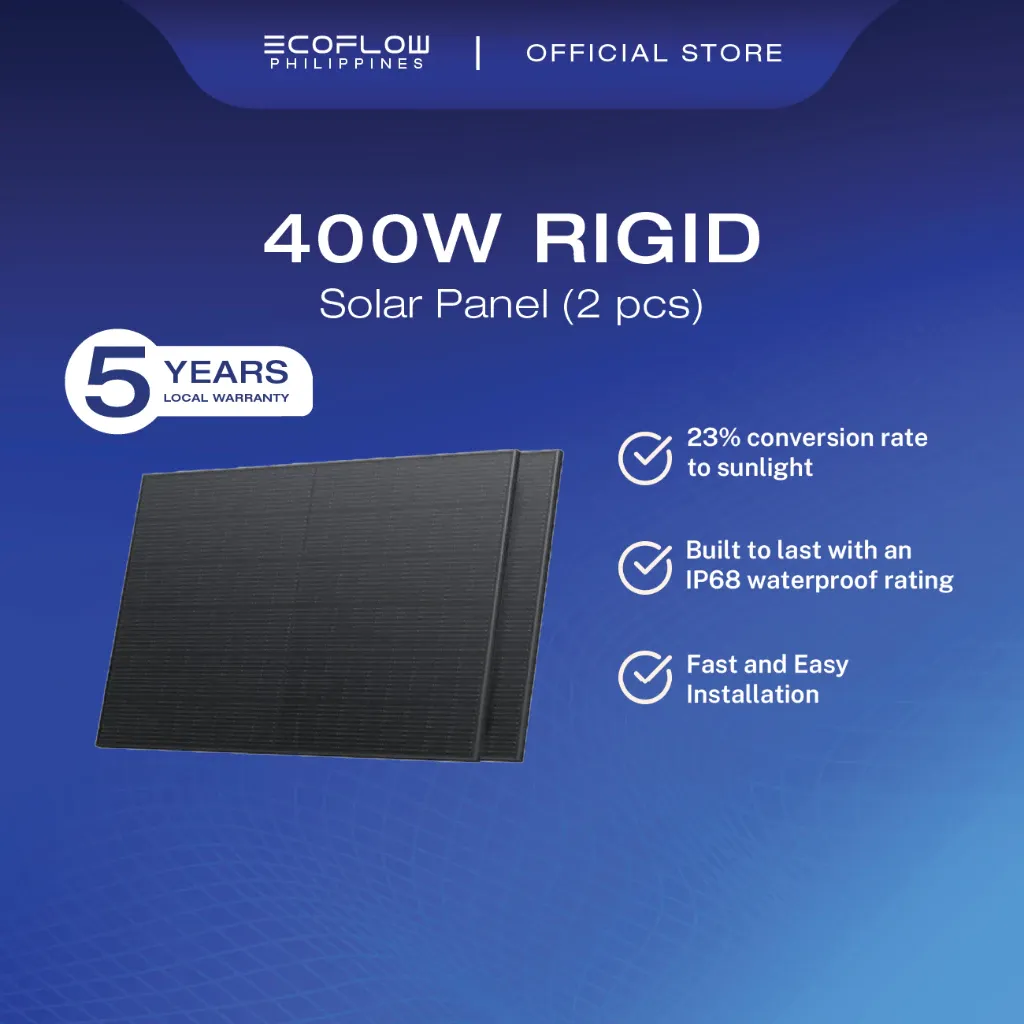
Sold through EcoFlow’s own Philippine Shopee store. The comparison worth making is against the 400W Rigid panel, which costs more, weighs 21.8kg, and cannot be moved once installed.
Who the EcoFlow 400W Portable suits
Buy this if you own a large power station, drive to where you use it, and want a full recharge inside an afternoon. It is the right choice for a family with a 1,000Wh-class battery in an outage-prone area, or for site work. It is the wrong buy for a small station. See how it ranks in our best solar panels in the Philippines roundup, or browse more on our Home Improvement page. Our solar panel buying guide covers matching panel output to battery size.
If the EcoFlow 400W Portable is not right
If the panel is going on a roof permanently, the EcoFlow 400W Rigid is built for that at around ₱40,000, with a 130 mph wind rating. For half the output at a much friendlier size and price, the EcoFlow 220W Lightweight weighs just 4.4kg at around ₱22,000.
Compare EcoFlow 400W Lightweight Portable Solar Panel
See how it compares with the other top picks in our solar panels comparison.
Frequently Asked Questions
Do I need 400W?
Only if you have a large battery to put it into. A 400W panel refills a 1,000Wh power station in about three hours of good sun, which is genuinely useful. Paired with a 256Wh station it is overkill, because the station cannot accept that much input at once.
How is this different from the 400W Rigid panel?
This one folds and comes with a kickstand case, so you can move it and aim it. The rigid 400W is a framed 21.8kg panel meant to be bolted to a roof and left there. Same output, completely different jobs.
What connector does it use?
MC4, which is the universal standard rather than an EcoFlow-only plug. That means it works with non-EcoFlow power stations and charge controllers without an adapter, which is unusual and useful at this size.
Are the published specs for this exact model?
Not entirely, and it is worth knowing. EcoFlow publishes a full sheet for its standard 400W portable panel (22.4% efficiency, IP68, MC4) but no separate sheet for the Lightweight variant. We have used the standard panel's figures as the closest reference rather than invent numbers.
More solar panels we've reviewed
Every card links to our full review.
Disclosure: Product Choicest is reader-supported. We may earn a commission when you buy through our Shopee links, at no extra cost to you. Read affiliate disclosure.
EcoFlow 400W Portable₱35,000 when last checked
See today's price 🛒