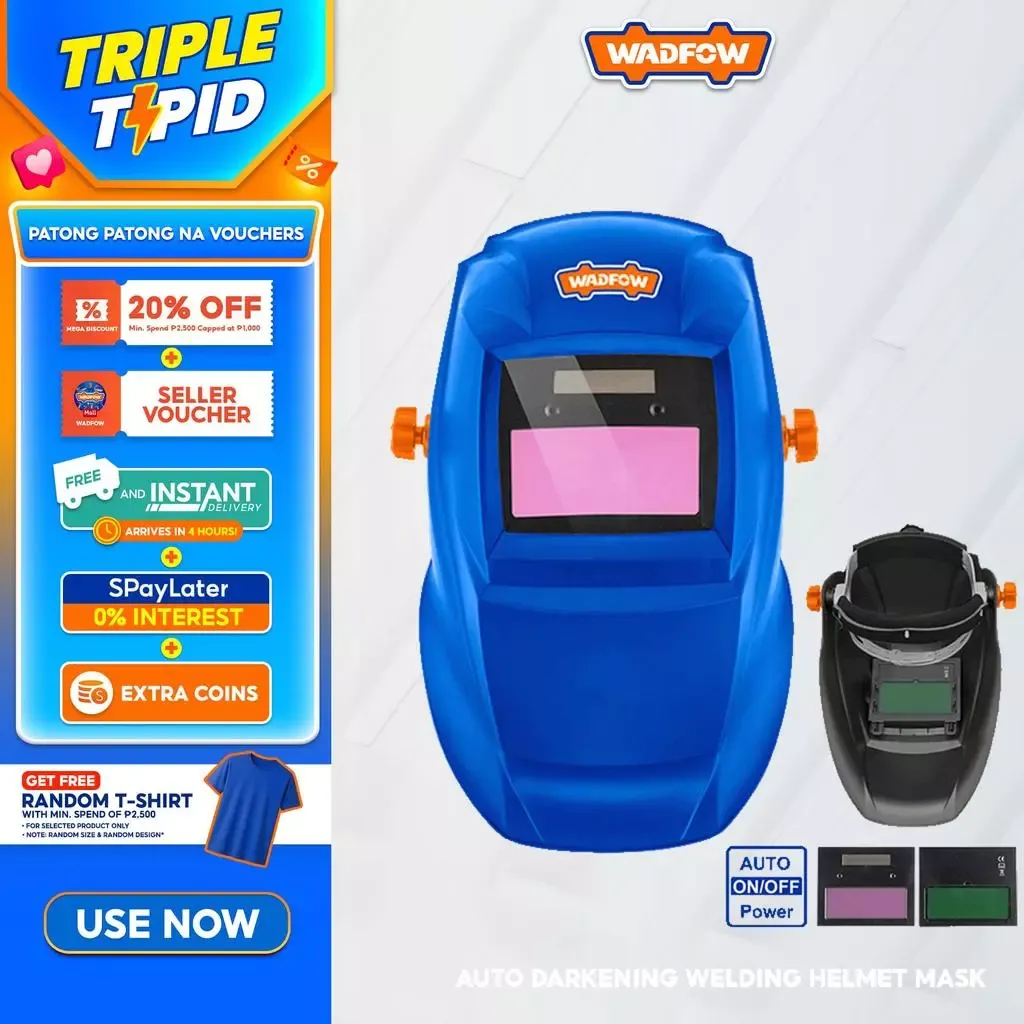
Wadfow WWH2501 Solar Auto Darkening Welding Helmet
₱798as of Aug 16, 2026
COD · Shopee-protected payment

Disclosure: Product Choicest is reader-supported. We may earn a commission when you buy through our Shopee links, at no extra cost to you. Read affiliate disclosure.
Our Best Budget pick: 1/25000 s switching and the clearest DIN 3 light state here for around ₱798, but the shade is fixed at 11.
₱798as of Aug 16, 2026
COD · Shopee-protected payment
| Brand | Wadfow |
|---|---|
| Type | Welding helmet |
| Price | ₱798 (as of Aug 16, 2026) |
| Owner rating | 4.8 ★ from 217 reviews |
| Shop | WADFOW |
| Units sold | 566 |
Specs per Wadfow published data for the WWH2501
| Type | Welding helmet |
|---|---|
| Shade control | Fixed shade 11, unadjustable |
| Light state | DIN 3 |
| UV/IR protection | DIN 16 |
| Switching time | 1/25000 s |
| Delay | Dark to light 0.2-0.5 s, automatic |
| Sensitivity | Automatic, unadjustable |
| Arc sensors | 2 |
| Filter size | 110 x 90 x 9 mm |
| Viewing area | 90 x 35 mm |
| Power | Solar cells and sealed lithium battery |
| Low amperage TIG | 15 A DC, 35 A AC |
The Wadfow WWH2501 is our Best Budget pick: 1/25000 s switching and the clearest DIN 3 light state here for around ₱798. The shade is fixed at 11.
A DIN 3 light state, the clearest in this comparison. That is how transparent the lens is before the arc strikes, and it is the state you position the rod and line up the joint in. A slightly clearer lens makes setting up in a dim corner of a workshop meaningfully easier.
1/25000 s switching, as fast as helmets costing twice as much.
Full DIN 16 UV and IR protection, which is the specification that actually protects your eyes. It applies whether or not the lens has darkened, so even a total electronics failure leaves you protected against the invisible damage. Several helmets in this comparison do not publish this at all.
A 15 A DC TIG rating, the lowest here. Thin-sheet TIG runs at low current, and a helmet rated only to 20 A may fail to trigger on it.
Two arc sensors, and fully automatic operation with nothing to set wrong.
The lens darkens to shade 11 and only shade 11.
For general stick welding around 100 to 200 A that is the right number, and for someone who owns one machine and runs it at one setting, the simplicity is arguably a feature.
Outside that band it is limiting. Low-amp TIG needs 9 or 10 to see the puddle; high-amp work wants 12 or 13. Neither is available, and the sensitivity is not adjustable either, so a partly obstructed arc may not trigger it.
The 90 x 35 mm viewing area is on the small side, and the sealed lithium battery cannot be replaced, so the helmet is finished when the cell eventually dies.
Around ₱798 as of August 16, 2026. Check the latest price on Shopee.
For the money, the specification is honest and complete: published UV/IR rating, published switching time, published TIG threshold. That transparency is worth something, and several pricier helmets here publish none of it.
The awkward comparison is that a variable-shade helmet exists at a similar price. If shade flexibility matters to you at all, spend the small difference. If you only ever run stick at mid amperage, this is genuinely good value.
Buy this if you run one machine at one setting, mostly stick around 100 to 200 A, and you want a fast, properly specified lens for as little as possible. See how it ranks in our best welding helmets in the Philippines roundup, or browse more on our Home Improvement page. Our welding helmet buying guide explains fixed against variable shade.
For a small amount more the Lotus LTWH300 gives you a variable DIN 9-13 shade and an adjustable delay, which is the upgrade that changes what you can weld. If you want a replaceable battery with your fixed shade 11, the INGCO AHM009 uses a standard CR2032 cell.
See how it stacks up against our top pick in the head-to-head Lotus LTWH300 Ironman Auto Darkening Welding Mask vs Wadfow WWH2501 Solar Auto Darkening Welding Helmet, or browse the full welding helmets comparison.
It is how clear the lens is before the arc strikes, and DIN 3 is the clearest here. That matters because you position the rod and line up the joint through the lens. A DIN 4 light state is slightly darker and makes setting up in a dim workshop a little harder.
It is the lowest current the sensors reliably detect on DC TIG, and 15 A is the lowest in this comparison. Thin sheet TIG runs at low current, and a helmet rated only to 20 A may fail to darken on it. If you TIG thin material, this is the relevant number.
Not for stick welding around 100 to 200 A, where 11 is the correct shade. It is limiting outside that: too dark to see the puddle on low-amp TIG, too light for heavy high-amp work. Variable-shade helmets exist at similar money, so weigh it before buying.
The lithium cell is sealed, so it cannot be replaced. When it eventually fails the helmet is finished. That is a real long-term cost, and it is worth comparing against helmets using a replaceable CR2032 cell instead.
Every card links to our full review.